Monday, October 28, 2013

Richard Beland the program coordinator is featured in the Sarnia Observer newspaper and online edition.


NEWS LOCAL
TEN: Richard Beland
Observer Staff
Sunday, October 27, 2013 10:14:42 EDT AM
http://www.theobserver.ca/2013/10/27/ten-richard-beland

Beland just can’t sit still Sarnia Observer 13-10-28 

Editor’s Note: Each Monday, the Observer will publish a Q&A with a local citizen to help readers better understand what makes him or her tick. Our subjects will come from all walks of life, but will have a strong connection to Sarnia-Lambton.

Richard Beland is an instructor and coordinator for Lambton College’s Digital Photography Program and is a working music and entertainment photographer. His extensive body of work, which dates back to 1993 and includes live performance photographs as well as studio portraits, celebrates popular music's depth and eclectic breadth. From photographs of Coldplay to those of The Tragically Hip, Beland's images of international stars and Canadian icons reveal his passion for his craft, his keen sense of composition, and his steadfast commitment to detail.

1. Who is your favourite entertainer?
Well, my rock and roll friends may be perplexed by this answer but, in all honesty, I have to say that Tony Bennett is one of the best performers I have had the opportunity to see and work with. He is a consummate professional. I’m also a big fan of Dave Grohl, mainly with the Foo Fighters, but in every band I’ve seen him play with. In my experience, Dave is one performer that always gives you his all. I can recall photographing him in the UK in the midst of a torrential rainstorm. He was drenched, the crowd was drenched, the photographers and their gear were drenched and, in spite of all this, he was unfazed. I’d say he worked even harder!

2. Who do you most admire and why?
My children and how they move through their young lives with limitless ability to see the beauty of life and its surroundings. They constantly and consistently inspire me.

3. What book has impacted you the most?
At the request of one of my students, I just read (I actually listened to the Audio Book) Animal Farm last week. One of my favorite albums, Pink Floyd’s Animals, was directly influenced by the story. So the actual story and the connection between the book and album both have had an impact on me.

4. How do you relax?
I don’t. I mean, I try but I don’t sit still very well. I intend on relaxing when I retire.

5. What is your most embarrassing moment?
Hmm... there are many. I’d say it was either when I was chased by a cow while walking along Modeland Road one day, or when Chris Martin from Coldplay heard me singing their song “Yellow.” Before our photo shoot, I was in the men’s room washing my hands, singing away in my best warbling falsetto like no one was listening. Mid-song Chris appeared from one of the closed stalls.

6. What career would you opt for if you could do anything else?
Without hesitation, an NHL hockey player.

7. What do you love most about living in Sarnia-Lambton?
I just returned back to the area after living in Toronto and London for the past 27 years. The things I love most about living here is access to Lake Huron in the summer. I had a really great childhood in Bright’s Grove and every corner I turn, I’m flooded with good memories. I’m also very happy to be close to my family and extended family that live here.


8. Name three things on your bucket list:
     1. To see the Pyramids in Egypt.
     2. To make the Lambton College Digital Photography Program the best in the province. 

     3. To live the answer to question #4 to the fullest.


9. What is something that few, if any people, know about you?
There are probably lots of things that people don’t know about me. Considering my lines of work, I’m incredibly shy. To be a photographer and an instructor I’ve had to learn how to overcome this but it still dogs me at the most inopportune times. Also, in my late teens, before I studied photography, I worked part time as a garbage man. I have the utmost respect for the garbage man.

10. What local resident has influenced you the most?
Am I allowed to say my kids again? In all seriousness there are too many people to name, but I have had an immense amount of help and guidance from my colleagues at Lambton College. They know who they are and I am grateful for everything they have taught me. Ultimately, if I had to choose one person I have to say my younger brother, Dave Beland. He has an admirable work ethic and a vast desire to learn. Despite being younger and maybe an inch shorter, I constantly find myself looking up to him.

To recommend someone to be featured in The Observer “10” series please email jack.poirier@sunmedia.ca. Please outline your rationale, what your nominee does and provide that person’s contact information. 

Wednesday, October 23, 2013

The 10,000 hour rule


I (Don) mentioned to my class on Monday that it takes 2,000 hours to become an expert at anything. I erred on the number, and an Internet search turns up the fact that it is 10,000 hours.
A couple examples are given: one is the Beatles, who became a great band after their sessions in Germany in their early years. They performed as many as nine hours a day and Lennon and McCarthy both have been recorded as saying that all the performance time resulted in a massive increase in skill levels.

The other example commonly mentioned is Bill Gates, who was a high school student who was allowed access to a computer (rare in the time when personal computers did not exist). He spent hours each night programming and developing his skills, so that when the personal computer revolution happened, he was ready to form a little company he called Micro-soft.
I mention this because sometimes as students you will complain about your work load. We are pushing you for a reason … we all know that experience is the best teacher, and the more time you spend taking photos, the more of the 10,000 hours you are filling in. That is why in an Art History course, 70% of your marks will come from photos  -- more often in that field you are assessed by writing essays and research papers.

I remember when I graduated from College (as a journalist) I was amazed that I learned more in the first three months on the newspaper than I did in two years at college. It was because I was now spending 40 hours a week as a reporter, and not the 5-10 I spent reporting while at college. For a short time I wondered if the time at college was a waste … then I realized that without what I learned in college, I would not have been able to do the job in those first three months. I suspect the same will happen for you when you graduate. You will learn much more in whatever you specialize in, but it will all be possible due to the background you are learning here in the program.

So, in short, you will not leave the program as an ace photographer. You need to get your 10,000 hours in first. We just hope that we have given you a head start on that goal by all the work you have done here at the college.

Wednesday, October 2, 2013

NYC - A look back

The second year students excursion is now complete, the experience was unforgettable as those of us in the department who were not involved have been hearing over the past few days.

Student Jeff McCoy joined Coordinator Richard Beland and Faculty Dave Chidley in a presentation about the Digital Photography Program to the Sarnia Photographic Club last night and Jeff spoke highly about the New York experience.   We are discussing another club presentation covering the trip in detail, once all of the images have been sorted and reflected upon.

Here are just a few more photos from the journey.


Monday, September 30, 2013

Explosive Streets of New York


Day 5 report by Aaron Esser and Jeff McCoy 

If you have ever been to New York you will understand the mass quantity of decisive moments that may occur in a split second due to the cities total population and visitors to the city. The decisive moment is a photographers dream and can happen so fast that it leaves an impression for a lifetime weather you catch the moment on camera or not.

How many times have you told a story to a loved one and had no picture to support the story? Many times right? For photographers the decisive moment is being aware of what is occurring around them at all times, while documenting the occurrence in the form of a photograph. Being a photographer also presents times where the decisive moment can back fire; either something prevented you from taking the photograph or your subject is not interested in the moment you vision behind your lens.

What is a Decisive Moment? The well-known father of the decisive moment was born in August 22, 1908. Henri Cartier-Bresson brought us modern photojournalism, candid and street photography (life reportage).

For many of us who visited New York this past week we would most likely tell you that we enjoyed the experience to its' fullest extent. This trip alone made the program worth it. Some obtained blisters, sore feet and backs, while others endured a fatigued state. Early mornings and late nights wondering popular and non-popular parts of New York took its toll on our bodies. The explosive energy around New York brought us the courage to forget that we just spent fourteen hours per-day away from our hotel room in order to better educate ourselves in culture, practice our photography, implement our skills and of course share with all of you.


The final day in 'The Big Apple'. The morning of our last day started nice and early. We packed up our gear to be ready for our six o'clock departure and headed to the largest independent photography and video store in the United States. B&H was massive, it was hard to take it all in knowing limited budgets applied. They have hundreds upon hundreds of cameras, lenses, computers, tripods and any other photography or video related thing you can think of. It was a very cool experience and we all wish we had bigger budgets to upgrade gear or check something off from our wish list. There really is no limit in gear and that is inspiring as a photographer.


After B&H we headed towards the subway, which would take us to our next destination in Central Park. While walking towards the subway Aaron was giving money to the less fortunate. Missing the decisive moment I asked Aaron to give the next person some money and I would document the exchange. While looking through the lens of the camera I noticed the women got up and starting running towards me. Frozen in time I pulled my camera away from my and eye and the girl starting yelling at me "don't" while pointing a finger. She continued to say "I have three teenage kids and it's embarrassing enough to be out here". I felt for her situation and tried to explain that I was a photography student and my intention was showcasing Aaron's generosity. Her and I came to terms with the situation and Aaron left the money along with many additional apologies.

This was one of those decisive moments that I never released my shutter. Part of me is very disappointed that I did not allow what we are learning in photojournalism to take precedence and capture the photograph. As photographers sometimes you have to let your heart step aside no matter what you are photographing. We all learned something in this scenario; take the photograph first and foremost. Secondly, understanding first- hand that tough situations will arise, be prepared for the unexpected decisive moment or battle with the moral right photograph. We are all thankful for David Chidley for sharing his knowledge with us. Upon not learning from him, I personally would not know what to do.

Arriving in Central Park for a video lesson with Troy Shantz and guest speaker Ken Maldonado. Ken is a freelance photojournalist who lives in Queens. He graduated with a degree in photography in 2007 and now works for the Wall Street Journal. Ken was successful in photography because he was "just being himself", he said. "Go after one thing and do it as best as you can" were words that stuck for all of us. The biggest thing that hit home for us was that he stressed the importance of being proactive and creative in how to approach potential clients. It was mentioned, "clients will not come to you, do not sit and wait for work. "Build relationships and do nothing for free if it’s going to cost you money " he added. Richard Beland, along with our other teachers has supplied us with a solid foundation thus far and it was really nice to hear a successful story such as Ken's. Hearing a story from a recent graduate really put our careers in perspective. Overall, cool experience and thank you Troy for setting this up for us.


Central park was beautiful. The sky was blue with a cool breeze. We walked through the park, which was full of families. People were leading others on horse and carriage, others doing shows for money on the street, and lots of people just walking around enjoying the beautiful day.


Jeff and Aaron started taking pictures of a juggler who was doing a show in front of several people after our inspiring conversation with Ken. While Jeff was taking a pictures of the show, the juggler called Jeff a creep and that one of the kids sitting in front of him better be his and if not leave a tip. Again this was a story that was shared on our way home and great learning experience. Jeff told me he was embarrassed in front of the crowd at Central Park and he was able to use learned techniques taught to him to be professional and understand that taking pictures to showcase the story happening in front of him can be perceived as 'creepy'.


On our way back to the hotel to gather our luggage every taxi seemed to have someone in it, the area was very busy. When we finally found one it wouldn’t take us because he was not familiar with the area we needed to go. We had to make a quick decision to stay in this cab or try another. We decided to try another cab. All taxi drivers where very friendly and offered assistance with our next destinations during our trip. On some occasions taxi drivers told us they were not familiar with the area in order to avoid heavy traffic areas. Getting another taxi was pretty simple though.


We all walked away with great memories, great experiences, and great photos. We flew in early Wednesday morning and had a non-stop five days. We visited exhibits, restaurants, subway rides, stores, landmarks, parks, bridges and much more.

From all of the year two students, thank you for being part of our experience. We hope you enjoyed the journey as much as we have!

PS. Jeff was stopped by the security guard for a random check at the airport on our way home. A security officer used a high-tech machine to heat a cardboard like sliver of paper the size of a thumb. The officer then rubbed the paper all around the palm of his hands. Jeff told me he watched the screen. He felt like it was taking a long time. Sure enough a red banner flashed. Inside the banner it read explosives detected. The funny thing is that Jeff asked to take a picture of the small room where he was searched. He will leave the 'strip search' to your imagination but at least he learned to always try and capture the decisive moment. 

**Editor's Note**  Check back tomorrow for one final instalment of the NYC trip Blog with some final images.


Sunday, September 29, 2013

Invigorating Adventure


Day 4 report by Angela Smolders and Fera Kennedy

The sun was shining upon New York City on our fourth day as we headed down to the Dumbo neighbourhood (an acronym for District Under the Manhattan Bridge Overpass), inbetween the Brooklyn and Manhattan bridges. Much to our delight, there was an arts festival and the area was brimming with artistic sights and sounds. The NYC Bhangra entertained us in a courtyard with their colourful costumes and poses. We were then treated to a strange and wonderful procession of people dressed like bubbles! As they marched past us blowing bubbles and playing music in their absurd costumes, it was like a scene from a Dr. Seuss book.


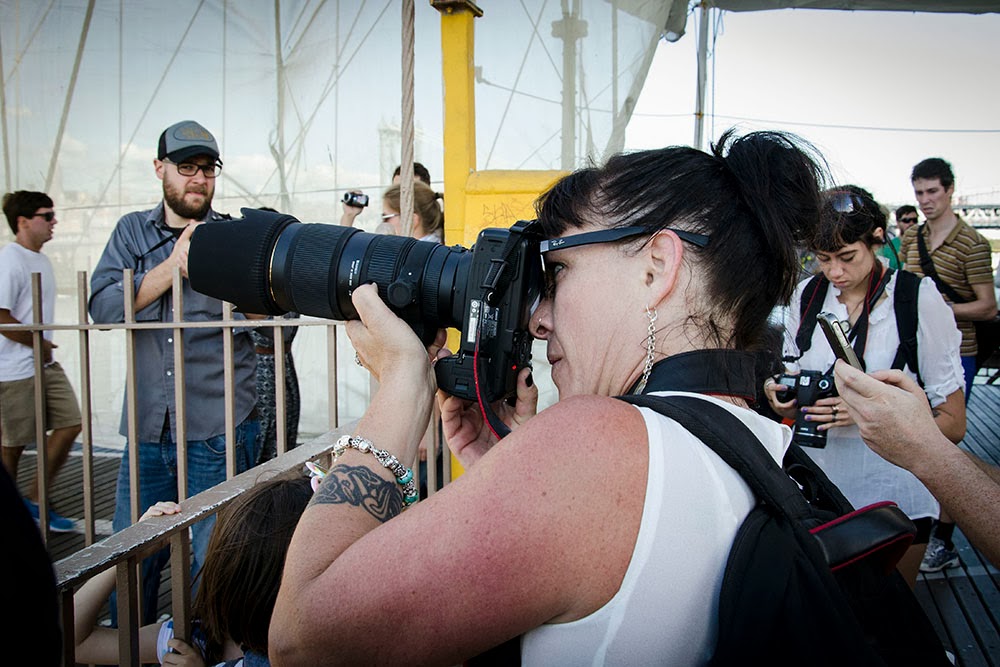
We took a leisurely stroll along the water and then headed towards Brooklyn Bridge to walk across it. Brooklyn Bridge is one of the oldest suspension bridges in the United States and was completed in 1883. It connects the boroughs of Manhattan and Brooklyn by spanning the East River. It is a New York City icon and has been designated a National Historical Landmark. As you walk higher and higher up the bridge, the scenery becomes even more beautiful and a new perspective of the city is gained.  Walking up the bridge and all along it is the most invigorating experience and a must do for travellers to the city. We were all in photography heaven up there!


After descending the bridge, we headed to a Buddhist Temple in bustling Chinatown located in Manhattan.  With an estimated population of 90,000 to 100,000 people, New York City’s Chinatown is the largest and oldest in the Western Hemisphere. The markets, shops, food, vendors and street life are truly fascinating.


After Chinatown, we visited Central Park and happened upon ‘Museum Mile’ – a beautiful stretch on Fifth Avenue spanning a mile and is chock full of museums and other fine arts institutions including the Metropolitan Museum of Art and the Guggenheim to name a few.

Central Park is so massive that it takes up 6% of Manhattan’s total acreage and includes seven bodies of water. We were able to watch the sunset along the largest body of water called the Jacqueline Kennedy Onassis Reservoir while a large fire was smoldering in the distance. We are excited to head back to the park tomorrow to have a Digital Video class at the Central Park Zoo!


We ended our beautiful day at Grand Central Station, which is celebrating its 100th birthday this year. It was way more grandiose than we had ever imagined with its marble floors and stairs and the iconic brass clock in the middle. The ceiling is painted with constellations and is 48 feet high! It was a surreal experience to view this historical landmark that is so often mentioned in books and has been in countless movies. It truly was a perfect ending to yet another adventurous day in New York City.